Your Kitchen Is a Chemistry Lab (And You've Been Running Experiments Every Night)
Your Kitchen Is a Chemistry Lab (And You've Been Running Experiments Every Night)
Most of us think of the periodic table as that laminated poster collecting chalk dust in a high school classroom — something you memorized once and promptly forgot. But here's the thing: the periodic table is alive in your kitchen right now. Every meal you cook, every spice you shake, every pan you scrub is a quiet encounter with the same elements that scientists spent centuries hunting down and naming. Let's take a walk through a typical American kitchen and see what's actually hiding in plain sight.
The Stovetop: Where Iron Rules
Start at the stove. If you're lucky enough to own a cast-iron skillet — the kind your grandma swore by and food bloggers obsess over — you're holding a solid slab of iron (Fe, element 26). Iron is one of the most abundant elements on Earth and has been shaped into tools and cookware for thousands of years. But here's the fun part: cooking with cast iron actually deposits tiny amounts of dietary iron into your food. That's not a metaphor. You are literally eating the periodic table when you scramble eggs in a well-seasoned cast-iron pan.
Over on the burner, if you've got a stainless steel pot, you're looking at an alloy — a mix of iron, chromium (Cr, element 24), and nickel (Ni, element 28). The chromium is what makes stainless steel stainless; it reacts with oxygen to form a thin protective layer that keeps rust from ruining your pasta night.
The Spice Rack: A Mineral Treasure Chest
Walk over to the spice rack. That humble little shaker of table salt? It's sodium chloride — a crystal made of sodium (Na, element 11) and chlorine (Cl, element 17). Both elements are wildly reactive on their own (sodium explodes in water; chlorine is a toxic gas), but bonded together they form something so safe and essential that humans have literally gone to war over it.
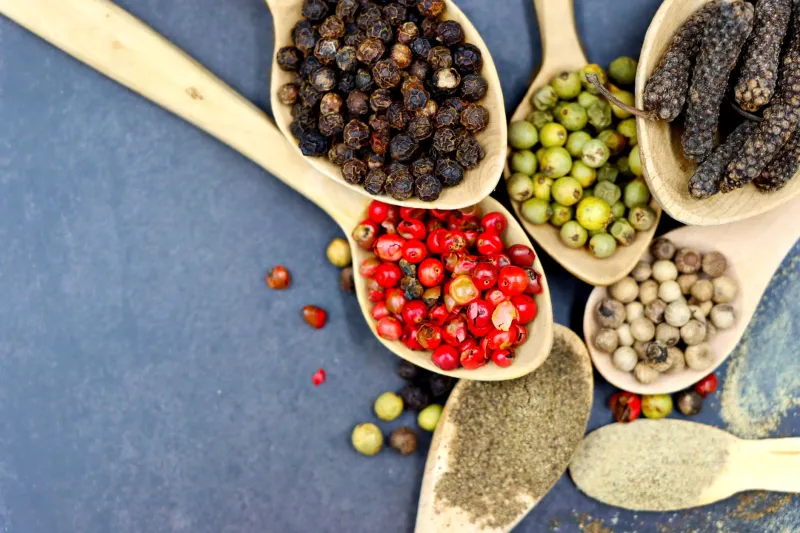
Salt is just the beginning. Turmeric contains trace amounts of manganese (Mn, element 25). Black pepper has potassium (K, element 19). Cinnamon? It's loaded with calcium (Ca, element 20) and even small amounts of iron. Your spice rack is basically a compact mineral supplement cabinet with better flavor.
The Fruit Bowl: Potassium's Greatest PR Campaign
Everybody knows bananas have potassium. It's one of those nutrition facts that managed to escape the science classroom and become actual common knowledge. But do people know why potassium matters? Element 19 is critical for nerve function and muscle contraction — including your heart muscle. Every time your heart beats, potassium ions are rushing in and out of cells to make it happen. So yes, the banana on your counter is keeping you alive. No pressure, banana.
Avocados, by the way, have more potassium per gram than bananas. They also contain magnesium (Mg, element 12), which plays a role in over 300 biochemical reactions in your body. That avocado toast isn't just trendy — it's elementally dense.
The Refrigerator: Cold Storage for Chemical Complexity
Open the fridge and the elemental inventory explodes. Milk and yogurt are rich in calcium and phosphorus (P, element 15) — two elements that work as a team to build and maintain your bones. Eggs contain sulfur (S, element 16), which is partly responsible for that unmistakable hard-boiled egg smell (hydrogen sulfide, anyone?). Leafy greens like spinach pack in iron, magnesium, and even traces of zinc (Zn, element 30), which supports immune function.
That bottle of multivitamins on the fridge shelf? It's basically a compressed greatest-hits album of the periodic table: iron, zinc, magnesium, iodine (I, element 53), selenium (Se, element 34), copper (Cu, element 29). Scientists didn't put those in there arbitrarily — each one plays a specific, irreplaceable biological role that your body can't manufacture on its own.
Under the Sink: The Cleaning Crew
Now let's get to the stuff people don't usually think about eating (please don't). Under the kitchen sink, you've got a whole different cast of elements at work. Bleach-based cleaners rely on chlorine compounds to kill bacteria. Dish soap often contains phosphate compounds built around phosphorus. Baking soda — which pulls double duty as both a baking ingredient and a natural cleaner — is sodium bicarbonate, putting sodium back in the spotlight.
Even the pipes delivering water to your faucet are part of the story. Older homes may have copper pipes; newer ones often use materials containing silicon (Si, element 14) or aluminum (Al, element 13). The water itself, depending on where you live, might carry dissolved calcium, magnesium, fluoride (fluorine, F, element 9), or chlorine — all added or naturally occurring for specific health and safety reasons.
Why Any of This Matters
Here's the thing about chemistry: it has an image problem. People hear "chemical" and they think danger, complexity, lab coats. But chemistry is just the language the universe uses to describe how matter behaves. When you cook dinner, you're not avoiding chemistry — you're doing it. You're facilitating reactions, transferring elements from one form to another, and building molecules your body will use to think, move, and breathe.
The periodic table isn't an abstract grid of abbreviations. It's a map of everything — including everything in your kitchen. Next time you reach for the salt, think of Humphry Davy, who isolated sodium in 1807 by running electricity through molten lye. Next time you slice a banana, think of element 19, discovered in 1807 as well (big year for chemistry, apparently).
Your kitchen has been a chemistry lab this whole time. You just didn't have the right tour guide.
Hungry for more? Explore our element profiles to dig deeper into the science behind your favorite foods.