Meet the Pink Rebel of the Periodic Table: Bismuth's Surprisingly Heroic Resume
Meet the Pink Rebel of the Periodic Table: Bismuth's Surprisingly Heroic Resume
Open the average American medicine cabinet and you'll find the usual suspects: aspirin, antacids, maybe some old cough syrup you keep meaning to throw away. But tucked in there — often sporting that unmistakable Pepto-Bismol pink — is a quiet chemical celebrity that most people couldn't name on a bet. That celebrity is bismuth, element 83 on the periodic table, and it's been doing more heavy lifting than it gets credit for.
Let's fix that.
The Forgotten Neighbor
On the periodic table, bismuth sits in a rough neighborhood. Its immediate neighbors are lead (famous for being toxic) and polonium (famous for being famously radioactive and deadly). With company like that, it's easy to understand why bismuth gets overlooked. It doesn't have uranium's dangerous mystique or gold's glamour. It just kind of... sits there, looking vaguely metallic and pinkish-silver, minding its own business.
But here's the thing: bismuth is genuinely fascinating, and its place between two notorious elements is actually part of what makes it special. It's the heaviest element on the periodic table that is considered effectively stable — meaning it doesn't decay fast enough to matter for any practical human timescale. Technically, bismuth-209 is very slightly radioactive, but its half-life is so incomprehensibly long (around 20 quintillion years, give or take) that calling it radioactive feels almost like a technicality. For all practical purposes, it's as stable as it gets.
In a row full of drama queens, bismuth is the chill one.
Renaissance Roots and a Case of Mistaken Identity
Bismuth's history stretches back further than most people realize. European miners in the 1400s were already digging it up, though for a long time they weren't entirely sure what they had. It kept getting confused with lead, tin, and antimony — all of which look somewhat similar in ore form. The confusion was so persistent that the German word Wismut, from which the modern name derives, was used as a catch-all for a whole mess of metallic substances that didn't quite fit other categories.
By the Renaissance, craftspeople had figured out that bismuth had some genuinely useful properties. It was mixed into low-melting alloys, used in early printing type, and ground into pigments. One of its compounds — bismuth white, also called Spanish white — became a popular cosmetic, used to lighten skin in 16th and 17th century Europe. People were literally rubbing bismuth compounds on their faces for beauty purposes centuries before they understood what an element actually was.
The formal recognition of bismuth as a distinct element came in the 18th century, when French chemist Claude François Geoffroy published work demonstrating that it was its own thing, separate from lead and tin. Chemistry was just starting to get its act together as a science, and bismuth was part of that great sorting-out.
From Cosmetics to the Pharmacy Aisle
The leap from Renaissance face powder to Pepto-Bismol is a long and winding one, but the key chapter involves bismuth's surprising biological behavior. Unlike its neighbors on the periodic table, bismuth compounds are remarkably non-toxic to humans at the doses used medicinally. This is genuinely unusual — most heavy metals are bad news for living things, but bismuth has a kind of biological indifference that makes it safe to swallow.
The active ingredient in Pepto-Bismol is bismuth subsalicylate, a compound that does several things at once. It coats the stomach lining, has mild antibacterial properties, and can inhibit the secretion of fluids in the intestines. The result? Relief from nausea, heartburn, indigestion, upset stomach, and diarrhea — a list so comprehensive it practically covers every bad thing that can happen to your digestive system on a rough Tuesday.
Bismuth subsalicylate has been used medicinally in various forms since the late 1800s, and the Pepto-Bismol formula has been around in recognizable form since the early 20th century. It's one of the most widely used over-the-counter medications in the United States. Millions of Americans reach for that pink bottle every year without ever once thinking, hey, I'm about to swallow a compound of a heavy metal that was once used in Renaissance makeup.
And that's kind of beautiful, honestly.
The Crystal Thing: Why Bismuth Is Also Gorgeous
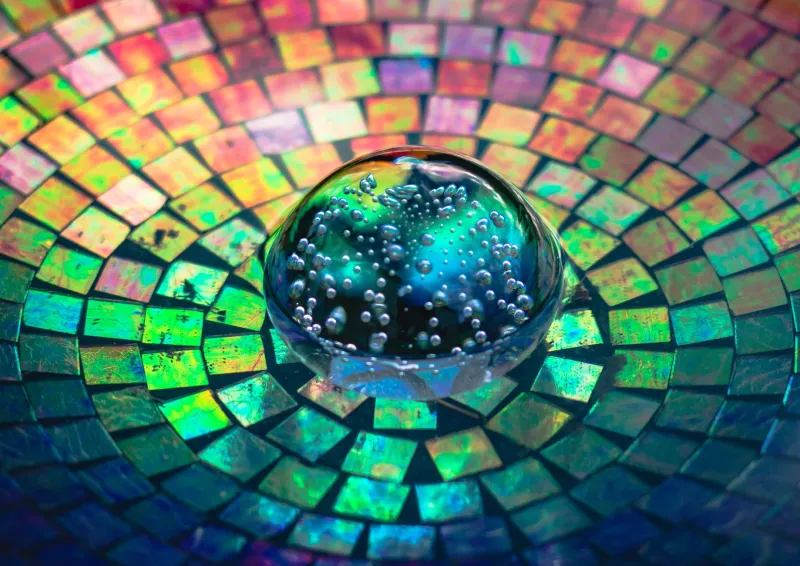
If you've ever seen a bismuth crystal — and if you haven't, please do yourself a favor and search for one right now — you know that this element has a visual identity completely at odds with its low-key reputation. Bismuth crystals form in staircase-like, geometric towers called hopper crystals, and they shimmer with an almost supernatural rainbow of colors: deep purples, electric blues, golden yellows, and greens.
Here's the science behind that visual magic. When bismuth oxidizes — meaning when the outer surface reacts with oxygen in the air — it forms an extremely thin layer of bismuth oxide. This layer is so thin that light waves reflecting off the top of the layer and the bottom of the layer interfere with each other, a phenomenon called thin-film interference. The same thing is happening when you see colors in a soap bubble or an oil slick on a puddle. The exact colors you see depend on the thickness of the oxide layer, which varies across the crystal's surface, creating that whole iridescent light show.
And the hopper crystal shape? That comes from bismuth's preference for growing faster at the edges of a crystal face than at the center. The result is those distinctive stepped, hollow squares that stack into towers. It's one of nature's more theatrical performances, and bismuth pulls it off with zero apparent effort.
The Lesson Buried in the Middle of the Table
Bismuth is a good reminder that the periodic table isn't just a list of elements ranked by fame or importance. It's a map of matter, and some of the most interesting stops on that map are the ones that don't get plastered on science classroom posters.
Here's an element that has been part of human life for six centuries — in our mines, our art, our cosmetics, our medicine. It sits quietly between two elements with genuinely terrifying reputations and manages to be completely benign, structurally stable, and weirdly beautiful. It's in your medicine cabinet right now, probably, waiting to be called upon during your next stomach emergency.
The next time you crack open that pink bottle, maybe take a second to appreciate what you're actually holding: a compound of element 83, a pinkish metallic rebel that survived centuries of mistaken identity, outlasted its dangerous neighbors in the public's good graces, and ended up being one of the most quietly useful substances in the average American home.
Not bad for an element nobody talks about.
Bismuth: element 83, atomic weight 208.98, and officially underrated.