Twenty-Nine Protons, No Substitute: Why Copper Has Electrification Over a Barrel
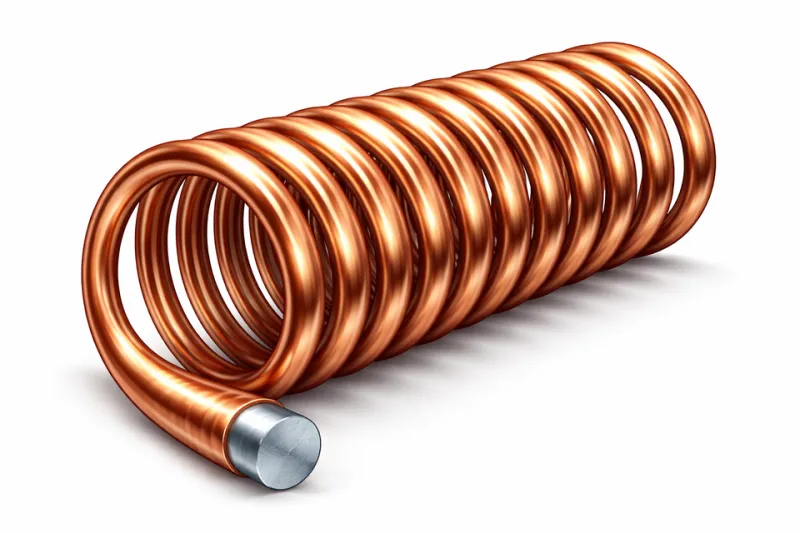
Photo: Pavlo Polishchuk, CC BY 4.0, via Wikimedia Commons
Copper is boring in the way that foundations are boring. Nobody puts it on a poster. It doesn't glow, it doesn't explode, and it won't win you a trivia night. But strip copper out of the modern world and the lights go off — literally, and in a way that has very little to do with the wire itself and everything to do with how electrons behave inside it.
That's the part worth understanding before we get to the shouting about mines and permits.
Why electron number 29 is so good at its job
Copper's electron configuration is [Ar]3d¹⁰4s¹. That dangling electron in the 4s orbital is loosely held, and in a solid chunk of metal it doesn't really belong to any single atom anymore. It sloshes around in a shared sea of charge. Apply a voltage and those electrons drift — not fast, mind you, on the order of millimeters per second actually — but the signal moves near the speed of light, because each electron shoves its neighbor and the shove propagates instantly down the wire.
Copper does this better than almost anything else at room temperature. Only silver beats it, and silver costs roughly eighty times more per ounce. So we settled on copper, and we've been settling on copper since the first telegraph lines went up.
There's a second trick that rarely gets credit: copper's corrosion product is self-limiting. Iron rusts into flakes that fall off and expose fresh metal. Copper oxidizes into a thin, tight green-brown patina that seals the surface and then more or less stops. That's why a copper roof from the 1800s still sheds water and why the Statue of Liberty hasn't dissolved into New York Harbor. Longevity is a materials property, and copper happens to be excellent at it.
The substitution problem, in plain numbers
Whenever a metal gets expensive or scarce, engineers start whispering about replacements. For copper, the list is short and unsatisfying.
Aluminum is the obvious candidate: light, cheap, abundant. But aluminum conducts only about 61 percent as well as copper for the same cross-sectional area. You can absolutely use it — utilities have strung aluminum transmission lines across the country for decades — but you need thicker conductors, and aluminum has a nasty habit of creeping and loosening at connections, which is exactly how you get hot spots. The aluminum branch wiring that went into a lot of American homes in the 1960s and 1970s became a genuine safety headache, and the Consumer Product Safety Commission spent years dealing with it. The lesson stuck.
Silver works beautifully and costs far too much for anything but switch contacts and high-end audio connectors.
Graphene and carbon nanotube conductors show up in press releases every few months. They are not winding motors in Ohio yet.
So the short answer is: you can substitute copper, at a cost in space, weight, efficiency, and reliability. In a data center where you're paying for every watt of cooling, or an EV where every pound is range, that cost gets real fast.
Where the demand is coming from
A conventional gasoline car carries somewhere around 40 to 50 pounds of copper — wiring harness, alternator, starter, connectors, the little motor in your seat. A battery-electric car runs closer to 180 pounds or more, because the battery pack, the motor windings, and the high-voltage wiring all need it. Same vehicle class, roughly triple or quadruple the copper.
Then stack the rest on top. Grid transmission and distribution upgrades. New substations. Wind turbines, which are copper-dense machines. Solar inverters and the wiring that stitches them together. And data centers, where the power distribution inside the building is essentially a copper sculpture with servers attached.
The awkward timing is that all of this demand arrives simultaneously, in a country whose grid was largely built between the 1950s and 1970s and is now being asked to carry loads its designers never imagined.
Supply doesn't move at software speed
The United States is not copper-poor. Arizona, Utah, New Mexico, Nevada, and Montana host serious deposits, and the Morenci and Bingham Canyon operations are among the largest holes humans have ever dug on purpose. But a mine is not a factory. You can't spin one up in eighteen months.
Permitting timelines in the US are frequently cited in the seven-to-ten-year range, sometimes longer, and that's before litigation. The Resolution Copper project in Arizona has been in various stages of argument for decades, tangled up in a land exchange and in the objections of Native American tribes who consider the site sacred. You can think that's a reasonable process or a maddening one — that's a policy debate, not a chemistry one — but either way, the metal doesn't come out of the ground while the lawyers talk.
Recycling helps, and it helps more than most people realize. Copper is one of the truly infinitely recyclable materials: melt it, cast it, and it performs identically to virgin metal. Roughly a third of US copper supply comes from scrap. But scrap supply is limited by how much copper was put into circulation twenty or thirty years ago, and it can't scale overnight either. It's a supplement, not a rescue.
What the periodic table is actually telling us
Here's the thing about copper that the supply-chain spreadsheets miss. Its usefulness isn't a coincidence of geology — it's a consequence of position. Elements in the middle of the transition series tend to have that combination of loosely held outer electrons, mechanical toughness, and chemical stubbornness that makes a good conductor and a durable one at the same time.
The periodic table didn't design a backup. It just gave us one element that's unusually good at all of it, and then buried most of the easy deposits in a handful of countries.
Which means the next decade of electrification is, in part, a metallurgy problem and a permitting problem and a scrap-collection problem, all wearing the same copper-colored hat. The volts have to get from here to there. Element 29 is how.