From Trash Heap to Tech Treasure: The Elements That Got a Second Chance
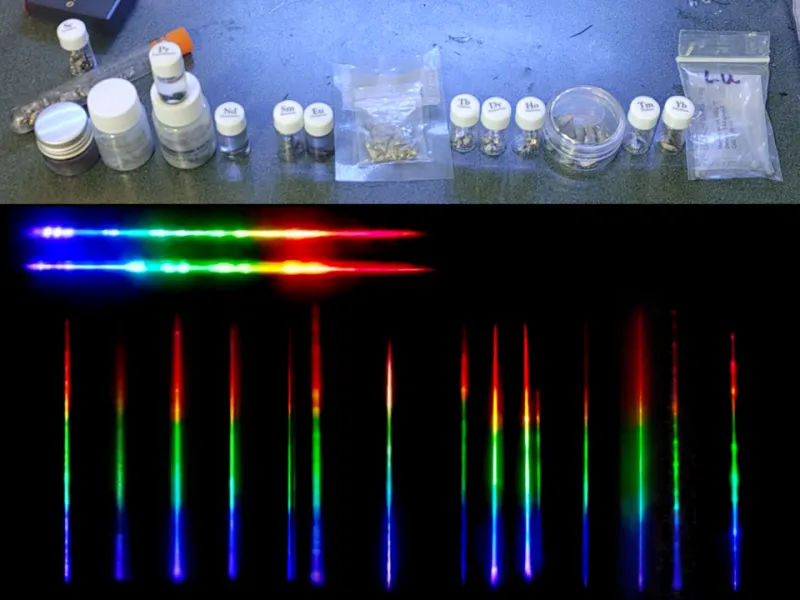
Photo: Umop503, CC0, via Wikimedia Commons
The periodic table doesn't play favorites. Every element is just atoms doing their thing, indifferent to whether humans find them useful. But humans absolutely play favorites — and we've been spectacularly wrong about which elements deserve our attention. History is littered with cases where scientists and industries dismissed entire swaths of the periodic table as worthless, only to scramble for them later when technology changed the game.
This is a celebration of the underdogs. The elements that sat in obscurity, got overlooked, got mocked, and then got the last laugh.
Lithium: From Psychiatric Ward to Power Grid
For most of the 20th century, lithium's main claim to fame was psychiatric medicine. Lithium carbonate was prescribed for bipolar disorder starting in the late 1940s, and while that's genuinely important, it didn't exactly make lithium a hot commodity. The element is soft, it reacts violently with water, and it seemed like a chemical oddity with limited industrial appeal.
Then came rechargeable batteries.
Lithium-ion battery technology, which matured commercially in the 1990s, transformed lithium into one of the most strategically important materials on Earth. Why lithium? Because it's the lightest metal on the periodic table, and lighter batteries mean longer-lasting laptops, phones, and — critically — electric vehicles. A single Tesla Model S battery pack contains roughly 60 kilograms of lithium. Multiply that by millions of EVs on the road and you start to understand why the US, China, and the European Union are all treating lithium deposits like geopolitical assets.
The so-called "Lithium Triangle" in South America — spanning parts of Chile, Argentina, and Bolivia — has become one of the most geopolitically contested regions on the planet, all because of an element that was once mainly known for stabilizing moods. The chemistry didn't change. The technology around it did.
The Rare Earth Elements: Ignored, Then Irreplaceable
The 15 lanthanides, plus scandium and yttrium, collectively known as rare earth elements, spent most of scientific history being a headache. They're chemically similar to each other, which makes separating them a nightmare. They have names that nobody can pronounce — praseodymium, dysprosium, gadolinium — and for a long time, nobody had a compelling reason to try.
Geologists would find them mixed into ore deposits and basically shrug. Mining operations considered them a nuisance byproduct. As recently as the 1980s, the rare earths were genuinely considered low-priority.
And then the modern world needed magnets.
Neodymium-iron-boron magnets, developed in the early 1980s, are the strongest permanent magnets ever created. They're in every hard drive, every electric motor, every wind turbine generator, every pair of earbuds you've ever owned. Dysprosium stabilizes those magnets at high temperatures — critical for electric vehicle motors that run hot. Europium and terbium produce the red and green phosphors in LED displays. Cerium is a crucial component in catalytic converters, quietly scrubbing pollution from hundreds of millions of car exhausts across America.
China recognized the strategic value of rare earths before most Western nations did, and today controls a dominant share of global production and processing. What was once geological trivia is now the subject of congressional hearings and international trade disputes.
Cobalt: The Accidental Superstar
Cobalt has been used in pigments for centuries — cobalt blue is one of the oldest synthetic colorants in existence, beloved by artists and ceramicists. But as an industrial material, it was mostly valued as a byproduct of copper and nickel mining. It was useful in certain specialty alloys for jet engines, sure, but "cobalt rush" was never a phrase anyone used.
Until battery cathodes.
Lithium-ion batteries in their most common formulations use cobalt oxide as a key component of the cathode material. Cobalt stabilizes the battery chemistry, improves energy density, and extends cycle life. The problem is that roughly 70% of the world's cobalt comes from the Democratic Republic of Congo, raising serious ethical concerns about supply chains. The scramble to either secure cobalt supplies or engineer batteries that use less of it has become one of the defining materials science challenges of the 2020s.
An element that colored Renaissance paintings is now a linchpin of the clean energy transition. Nobody saw that coming.
Indium: The Element That Lets You Touch Your Screen
Indium is element 49, a soft silvery metal that was discovered in 1863, named for the indigo color of its spectral lines, and then mostly ignored for the better part of a century. It occasionally showed up in low-friction alloys or dental work, but it was genuinely considered a minor player.
Then someone figured out that indium tin oxide (ITO) is transparent and electrically conductive. That combination is extraordinarily rare among materials. And that property is exactly what touchscreens need — a coating that lets light through while also registering your finger's electrical signature.
Every smartphone, tablet, and ATM touchscreen in America almost certainly uses indium tin oxide. The global demand for indium went from negligible to urgent in the span of a decade. It's still primarily recovered as a byproduct of zinc smelting, which makes supply somewhat unpredictable. Researchers are actively searching for alternatives, but for now, indium is the invisible ingredient in every screen you've tapped today.
Gallium: The Metal That Melts in Your Hand (And Runs Your Phone)
Gallium has a party trick: it melts at just 85.6°F, meaning it literally liquefies in your palm. For a long time, that was the most interesting thing about it. It was a curiosity, a novelty, something to show off at chemistry demonstrations.
But gallium arsenide and gallium nitride semiconductors turned out to be dramatically better than silicon for certain applications — particularly anything involving light or radio frequencies. The LEDs that light up every traffic signal and indicator light in the country? Gallium-based semiconductors. The 5G radio chips in your phone? Gallium nitride. The laser in your Blu-ray player, if you still have one? Gallium.
China, which produces the vast majority of the world's gallium, briefly imposed export controls on it in 2023, sending a clear message about how critical this once-novelty element had become.
The Lesson the Periodic Table Keeps Teaching
There's a pattern here that's worth sitting with. Again and again, elements get dismissed as useless until a new technology arrives that needs exactly what they offer. The chemistry was always there. The atoms were always doing the same things. It was human ingenuity — and human need — that revealed the value hiding in plain sight.
The periodic table has 118 confirmed elements. A handful of them do most of the heavy lifting in our daily awareness — oxygen, iron, carbon, gold. But tucked into the corners, especially in those rows at the bottom that get printed separately like an afterthought, are dozens of elements waiting for their moment.
If history is any guide, some of them are about to have a very good decade.