They Show Up, Do the Work, and Never Get Used Up: The Secret Life of Catalysts
Imagine hiring a contractor who renovates your entire kitchen, charges nothing, and leaves without taking a single tool or scrap of material. Sounds too good to be true, right? In chemistry, that contractor exists — and we call it a catalyst.
Catalysts are substances that speed up chemical reactions without being permanently consumed in the process. They lower the energy barrier a reaction needs to clear (chemists call this the activation energy), essentially giving molecules a boost so they can connect, break apart, or rearrange faster than they'd manage on their own. When the reaction wraps up, the catalyst is still there, ready to do it all over again. It's one of the neatest tricks in all of science.
And it's not some niche lab curiosity. Catalysts are woven into nearly every corner of modern life — your morning coffee, your car, your body, and the fertilizer that helped grow your breakfast.
The Matchmaker Analogy (Bear With Us)
Think of a chemical reaction like two awkward strangers who'd make a perfect couple but are too nervous to introduce themselves. Left alone, they might eventually bump into each other — but it could take forever, and the energy required to break the ice is enormous.
A catalyst is the friend who drags them both to the same party, sits them next to each other, and makes the introduction. The couple gets together. The friend goes home alone, unchanged, ready to do it again at the next party.
That's the core magic: the catalyst participates in the reaction temporarily — it might bond with one molecule, hold it in just the right position, weaken a particular chemical bond — but by the end, it pops back out in its original form. No wear and tear. No depletion. Just endless, tireless facilitation.
The Converter Under Your Car Is a Chemistry Marvel
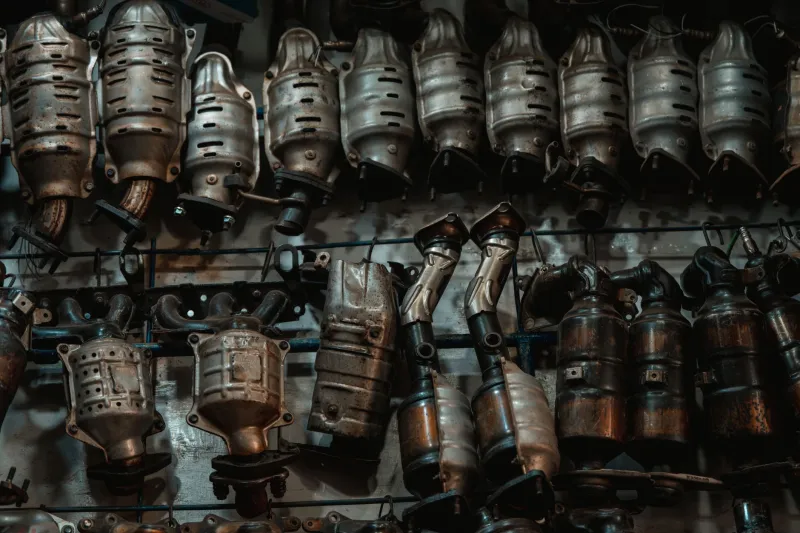
One of the most familiar catalysts in American life is the catalytic converter, that canister bolted to your exhaust system that you only think about when the check-engine light comes on.
Internal combustion engines are messy. They produce carbon monoxide (poisonous), unburned hydrocarbons (smoggy), and nitrogen oxides (acid rain precursors). Before the 1970s, all of that went straight into the air. Then catalytic converters became mandatory in the US, and the chemistry got to work.
Inside the converter is a honeycomb structure coated with tiny amounts of platinum, palladium, and rhodium — precious metals that act as catalysts. Hot exhaust gases flow over this surface, and the metals facilitate a set of reactions that convert the nasty stuff into carbon dioxide, water, and nitrogen gas. Not perfect outputs, sure, but dramatically less harmful than what went in.
The platinum doesn't get used up. It just keeps doing its job, reaction after reaction, mile after mile. That's why a well-maintained catalytic converter can last the life of a vehicle.
Your Body Is Basically a Catalysis Machine
Here's where it gets personal. Right now, without any conscious effort on your part, roughly 37 trillion cells in your body are running thousands of chemical reactions every second. Digesting food. Repairing DNA. Building proteins. Generating energy.
None of that would happen fast enough to keep you alive without enzymes — which are biological catalysts, and honestly, they're spectacular.
Enzymes are proteins that have evolved over billions of years to be incredibly specific. The enzyme amylase in your saliva starts breaking down starch the moment food hits your mouth. The enzyme catalase in your liver dismantles hydrogen peroxide (a toxic byproduct of metabolism) into harmless water and oxygen so fast it's almost incomprehensible — one catalase molecule can handle about 40 million hydrogen peroxide molecules per second.
That's not a typo. Forty million. Per second. Per molecule of enzyme.
Without catalase doing that work, your cells would essentially rust from the inside out. Enzymes are why life at the speed and complexity we know it is even possible.
The Haber-Bosch Process: Feeding the Planet
If you want a single example of how industrial catalysis changed human history, look no further than the Haber-Bosch process — the chemical reaction that produces ammonia for fertilizer.
Nitrogen makes up about 78% of the air we breathe, but atmospheric nitrogen is stubbornly unreactive. Plants can't use it directly. For most of human history, the amount of food we could grow was limited by available nitrogen in the soil.
In the early 1900s, Fritz Haber and Carl Bosch figured out how to force nitrogen and hydrogen to react under high pressure and temperature using an iron-based catalyst. The result: synthetic ammonia, which became the foundation of modern fertilizers.
Today, roughly half the nitrogen in the human body came through the Haber-Bosch process at some point. It's estimated to support food production for about half the world's population. And at the center of that world-altering chemistry? An iron catalyst, doing its quiet, tireless work.
The Race to Build Better Catalysts
Scientists aren't just admiring the catalysts nature and industry already gave us — they're obsessed with designing new ones.
A huge area of research right now is green catalysis: finding ways to run important industrial reactions at lower temperatures, with less energy, using cheaper and more abundant materials. Platinum works beautifully, but it's expensive and rare. Researchers are hunting for catalysts made from nickel, iron, or even organic molecules that can do comparable jobs.
There's also enormous excitement around photocatalysis — using light to drive reactions. Certain semiconductors, like titanium dioxide, can absorb sunlight and use that energy to catalyze reactions. Scientists are exploring this for everything from splitting water to produce hydrogen fuel to breaking down pollutants in contaminated water supplies.
And then there's the frontier of enzyme engineering, where biochemists tweak the structure of natural enzymes — or design entirely new ones from scratch — to catalyze reactions that don't even exist in nature. The pharmaceutical industry is particularly interested, since custom enzymes can build complex drug molecules with far less chemical waste than traditional synthesis.
Why This All Matters
Catalysts don't get nearly enough credit. They're not glamorous. They don't show up in the final product. They never take a bow.
But strip them out of the picture and the modern world collapses pretty quickly. No affordable fertilizer. No emission controls on cars. No metabolism. No pharmaceuticals made at scale. No clean energy future built on hydrogen.
Every time you fill up your gas tank, swallow a bite of food, or take a vitamin, you're benefiting from the work of catalysts — molecular agents that have been quietly bending the rules of chemistry on your behalf, completely free of charge, since long before humans had any idea they existed.
That's not just useful. That's kind of beautiful.
And somewhere in a lab right now, a chemist is designing the next generation of them, trying to convince molecules to do things they've never done before. The invisible workers keep multiplying.