Sand, Chips, and Solar Panels: How the World's Most Boring Element Became Its Most Important
Pick up a handful of sand at the Jersey Shore or on a California beach and you're holding one of the most consequential substances in human history. It doesn't look like much. It doesn't glow, it doesn't react dramatically, it doesn't do anything interesting at a barbecue. But that gritty handful is mostly silicon dioxide — and silicon, element 14 on the periodic table, is the quiet engine behind basically everything you do in a day.
Your morning alarm? Silicon. The GPS that got you to work? Silicon. The solar panels on your neighbor's roof? Definitely silicon. For an element that doesn't even appear on its own in nature, it sure has made itself indispensable.
From Rock to Revolution
Silicon is the second most abundant element in Earth's crust, right behind oxygen. It's everywhere — in rocks, soil, clay, and yes, sand. The problem is that raw silicon isn't particularly useful. It sits in a chemical compound called silicon dioxide (SiO₂), which is just a fancy name for quartz or sand, and it takes serious industrial effort to liberate the pure silicon underneath.
That process involves heating silicon dioxide with carbon at extremely high temperatures — around 3,000°F — in giant electric arc furnaces. What comes out is metallurgical-grade silicon, which is still not pure enough for electronics. To get to semiconductor-grade silicon, you need to refine it further until you've got material that's 99.9999999% pure. That's nine nines. The semiconductor industry calls it "nine nines pure," and achieving it is one of the great feats of industrial chemistry.
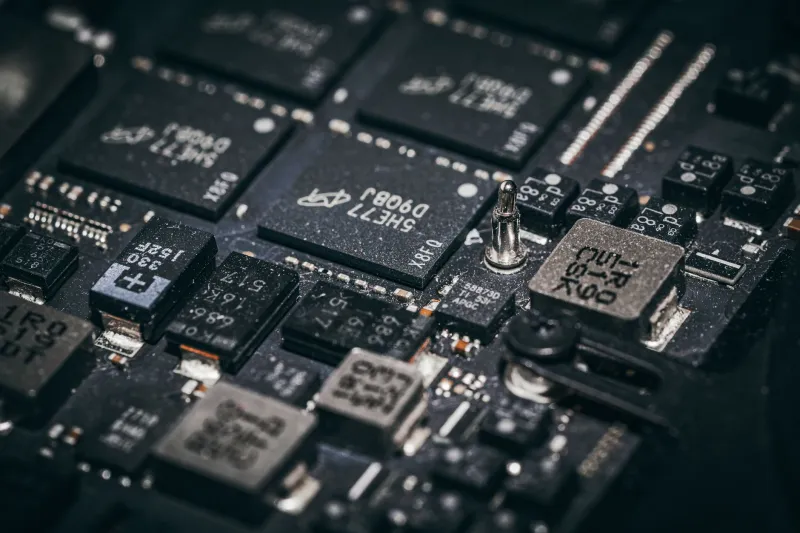
Why does purity matter so much? Because silicon's superpower is being a semiconductor — a material that can conduct electricity under some conditions and block it under others. That switchable behavior is what makes transistors possible, and transistors are the tiny on/off switches that make all digital computing work. A modern smartphone processor contains somewhere around 15 to 20 billion transistors crammed into a chip smaller than your fingernail. Each one is essentially a microscopic silicon gate that flips billions of times per second.
The Doping Game
Here's where silicon's chemistry gets genuinely clever. Pure silicon is a decent semiconductor, but it gets dramatically more useful when you intentionally contaminate it — a process called doping. Add a tiny amount of phosphorus (which has one extra electron compared to silicon) and you create n-type silicon, which has extra negative charge carriers. Add a bit of boron instead, and you get p-type silicon, which has "holes" that act like positive charge carriers.
Stack an n-type layer against a p-type layer and you've got a p-n junction — the fundamental building block of diodes, transistors, and solar cells. It's an elegant piece of atomic engineering that changed the course of human history, and it started with deliberately putting impurities into an otherwise extremely pure material. Chemistry is full of beautiful contradictions like that.
Silicon Valley Got Its Name for a Reason
The semiconductor industry didn't end up in the San Francisco Bay Area by accident. In the 1950s and 60s, a cluster of companies — Fairchild Semiconductor, Intel, and dozens of others — set up shop around Stanford University, drawn by research talent and defense contracts. They were all working with silicon, and the nickname stuck. Today "Silicon Valley" is shorthand for the entire tech industry, which is kind of remarkable for an element that resembles dirty gray metal.
The pace of progress in silicon-based computing followed what became known as Moore's Law — the observation by Intel co-founder Gordon Moore that the number of transistors on a chip roughly doubled every two years. For decades, that held true. Chips got faster, cheaper, and more power-efficient on a breathtaking schedule. Your phone today is genuinely more powerful than the computers NASA used to land humans on the moon, and silicon is why.
The Wall Everyone Knew Was Coming
But here's the thing about doubling transistor counts indefinitely: eventually, physics says no. Transistors on cutting-edge chips are now measured in nanometers — a few atoms wide. When you get that small, quantum mechanical effects start causing problems. Electrons tunnel through barriers they're supposed to be blocked by. Heat becomes catastrophic. Leakage current eats into efficiency. The industry has been bumping up against these limits for years, and Moore's Law has noticeably slowed.
So what comes after silicon? That's the billion — actually, trillion — dollar question.
The Contenders Lining Up
Several materials are gunning for silicon's crown, each with its own strengths. Gallium nitride (GaN) already handles high-power applications better than silicon — it's in the compact fast-chargers that have replaced those bulky laptop bricks. Silicon carbide (SiC) is showing up in electric vehicle power systems because it handles heat and high voltages more efficiently. Neither is replacing silicon in processors, but they're carving out territory.
For the most ambitious applications, researchers are excited about graphene, a single-atom-thick sheet of carbon that conducts electricity with almost no resistance. It's theoretically ideal for ultra-fast transistors. The catch? Manufacturing graphene at scale, defect-free, remains extraordinarily difficult. It's been "five to ten years away" from commercial viability for about fifteen years now.
Quantum computing takes a completely different approach, using quantum mechanical properties of particles — including, interestingly, silicon-based qubits in some designs — to perform certain calculations that would take classical computers the age of the universe to solve.
Silicon Isn't Going Anywhere
Here's the honest truth: silicon isn't getting dethroned anytime soon. Decades of investment in silicon manufacturing infrastructure, design tools, and engineering expertise means the industry will keep squeezing performance out of it long after the easy gains are gone. Techniques like 3D chip stacking, where multiple silicon layers are built on top of each other, are already extending the technology's life.
And in solar energy, silicon is having a genuine second act. Photovoltaic panels — the kind on rooftops across America — are mostly silicon-based, and they've gotten dramatically cheaper and more efficient over the past decade. As the US pushes toward cleaner energy, silicon is doing double duty: running the computers that model climate change and generating the electricity that might help slow it.
Not bad for beach sand.
Element 14 never asked to be interesting. It doesn't have bismuth's rainbow iridescence or phosphorus's eerie glow. It just showed up, played well with others, and quietly built the modern world. That's a kind of elemental heroism worth paying attention to.