The Original Mad Scientists Were Right About Almost Everything (Except the One Thing That Mattered)
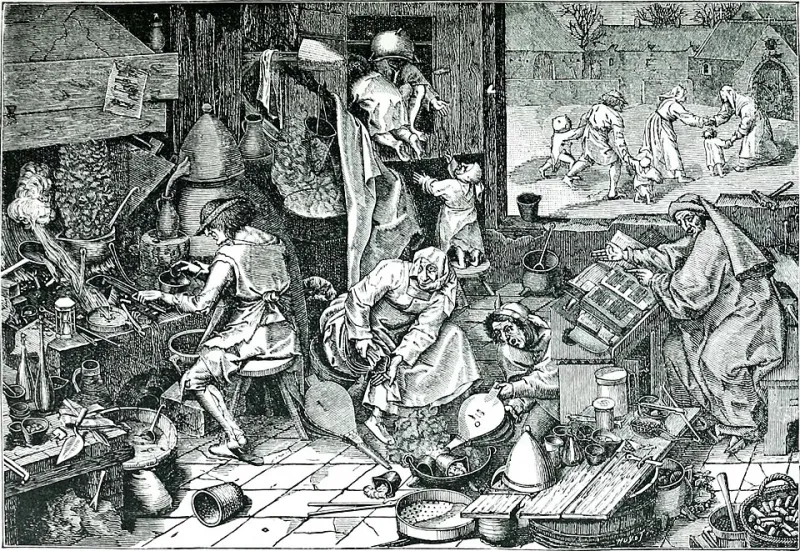
Photo: Internet Archive Book Images, No restrictions, via Wikimedia Commons
Picture the classic alchemist. Hunched over a smoky furnace, muttering incantations, surrounded by bubbling flasks and cryptic symbols. Maybe a skull on the desk. Definitely a bad beard. History has mostly filed these folks under "colorful failures" — people who wasted their lives chasing gold that was never coming.
But that framing is doing them a serious disservice. Alchemists didn't discover the philosopher's stone. They didn't transmute lead into gold (well, not chemically — particle accelerators technically can, but that's a different article). What they did do, accidentally and obsessively over roughly 2,000 years, was build the entire scaffolding that chemistry would later move into.
They got the ending wrong. They got almost everything else surprisingly right.
Where Alchemy Even Came From
Alchemy wasn't one thing. It emerged independently in ancient Egypt, China, and the Islamic world before eventually flooding into medieval Europe, and each tradition brought its own flavor. Egyptian alchemists were largely interested in metalworking and dyes — practical stuff. Chinese alchemists were often chasing immortality elixirs (some of which contained mercury and arsenic, which is a fascinatingly counterproductive approach to living forever). Islamic scholars like Jabir ibn Hayyan, working in the 8th century, were doing something that looks startlingly close to actual empirical chemistry.
Jabir — known in the West as Geber — described processes like distillation, crystallization, and calcination with enough precision that later chemists could follow his instructions. He identified strong acids. He classified substances into categories based on observable properties. He kept records. That last part is huge. The writing it down part is basically science.
The Techniques That Survived the Dream
Here's a fun exercise: walk through a chemistry lab and count how many pieces of equipment have direct alchemical ancestry.
The alembic — a distillation apparatus — was refined by alchemists and is still the conceptual ancestor of every distillation column in use today, including the ones making your bourbon. The water bath (bain-marie in French, named after a legendary alchemist called Mary the Jewess) is still standard lab technique for gentle, controlled heating. Filtration, sublimation, amalgamation — all of these processes were documented, refined, and passed down through alchemical tradition before chemistry existed as a word.
Alchemists also discovered actual elements. Phosphorus was isolated in 1669 by Hennig Brand, a German alchemist who was boiling down enormous quantities of urine looking for the philosopher's stone. (We covered phosphorus in a previous article, and yes, it starts with urine every single time.) Antimony, arsenic, bismuth, and zinc were all characterized during the alchemical period. These weren't mystical discoveries — they were the result of people systematically heating, mixing, and observing materials over and over again.
That's proto-scientific method. Rough, messy, motivated by the wrong goal, but recognizably empirical.
What They Fundamentally Misunderstood
So why didn't it work? Why couldn't all that diligent experimentation eventually produce gold?
Because the alchemists had no concept of the atom.
To an alchemist, substances were defined by their qualities — hot, cold, wet, dry — inherited from Aristotelian philosophy. Lead was lead because it expressed certain qualities in certain proportions. Gold was gold for the same reason. If you could just rearrange the qualities, you could theoretically rearrange the substance. The philosopher's stone was imagined as a kind of ultimate quality-adjuster.
What they couldn't know — what nobody knew until John Dalton started formalizing atomic theory in the early 1800s — was that lead is lead because it has 82 protons in its nucleus. Gold has 79. Those aren't qualities. They're fundamental, fixed properties of matter at a nuclear level. No amount of heating, dissolving, or mystical intervention rearranges protons. You need a particle accelerator and a budget that makes no economic sense whatsoever.
The alchemists were operating with an entirely wrong model of what matter is. And yet, working inside that wrong model, they accumulated an enormous library of real, reproducible observations about how substances behave. It's a little like building an accurate road map of a city while believing the city is located on the moon.
The Transition to Chemistry Wasn't a Sudden Break
History books love a clean narrative: alchemy = superstition, chemistry = science, revolution happens, enlightenment ensues. The actual transition was much murkier.
Robert Boyle, often called the father of modern chemistry, published The Sceptical Chymist in 1661 — a book that challenged Aristotelian element theory and pushed for a more rigorous, experimental approach. Boyle is firmly in the chemistry column. He also spent a significant portion of his life actively trying to transmute metals and corresponded extensively with other alchemists. Isaac Newton — Isaac Newton — wrote more about alchemy than he did about physics. His private papers, only fully analyzed in the 20th century, reveal someone deeply embedded in alchemical thinking even as he was revolutionizing our understanding of gravity and light.
The line between alchemist and chemist was blurry for a long time, because the practices overlapped heavily. What changed wasn't the techniques — it was the theoretical framework and, crucially, the willingness to let experiments falsify your assumptions.
Their Failures Were the Foundation
Every experiment that didn't produce gold still produced data. Every substance that didn't transmute still revealed something about how matter behaves under heat, pressure, or in solution. The alchemists built a centuries-long database of chemical observations, and when Lavoisier, Dalton, Mendeleev, and others came along with better theoretical tools, they had a rich body of empirical work to interpret.
Mendeleev's periodic table — the organizing principle of all modern chemistry, the thing this entire website is named after — was built on elemental properties that alchemists spent generations documenting without ever fully understanding.
So the next time someone dismisses the alchemists as history's most elaborate dead end, push back a little. They were chasing an impossible goal with an incorrect model of the universe. But they were doing the work. They were heating things up, writing it down, and asking why.
That's not so different from what scientists do today. Except now we know where the protons are.