Blood, Batteries, and the Blue Metal Nobody Talks About
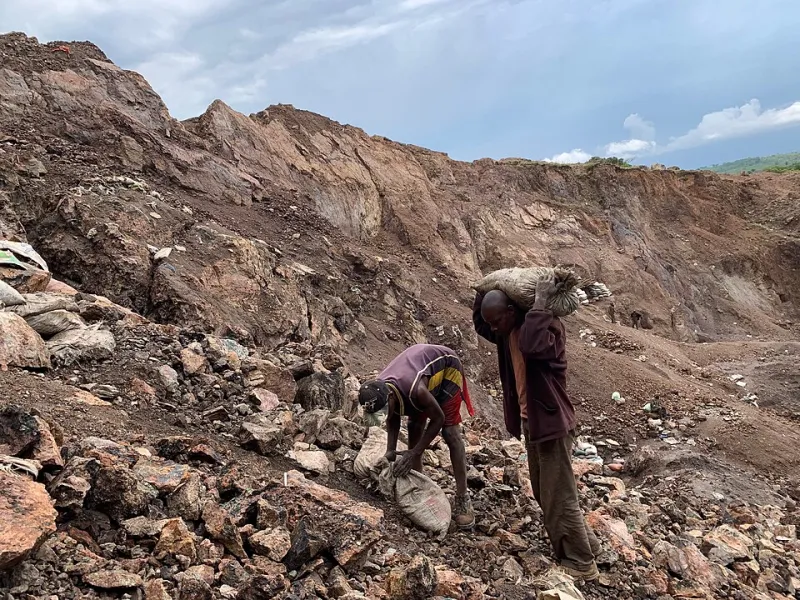
Photo: The International Institute for Environment and Development, CC BY 2.5, via Wikimedia Commons
You probably charged your phone last night. Maybe your laptop too. You set them on the nightstand, plugged in, and didn't think twice. That's fair — that's how technology is supposed to work. Seamlessly. Invisibly. But inside that little brick of a battery, there's an element doing some seriously heavy lifting, and its backstory is anything but seamless.
Meet cobalt. Atomic number 27. A hard, bluish-gray transition metal that's been quietly running your digital life for decades.
What Cobalt Actually Does in Your Battery
Lithium-ion batteries — the kind in your phone, your laptop, your EV, your wireless earbuds — are basically tiny electrochemical ping-pong matches. Lithium ions bounce back and forth between two electrodes every time you charge or discharge. The cathode, which is the positive electrode, needs to be stable enough to handle thousands of those cycles without falling apart.
That's where cobalt earns its paycheck. In the most common cathode chemistry (called NMC, or lithium nickel manganese cobalt oxide), cobalt acts as a structural stabilizer. It keeps the electrode from degrading too fast, which means your battery holds a charge longer and doesn't puff up like a sad balloon after a year of use. Without cobalt, current battery tech would be noticeably worse — shorter range, shorter lifespan, and a lot more fire risk.
Some newer battery designs are trying to reduce cobalt content or cut it out entirely. Tesla's LFP (lithium iron phosphate) cells skip cobalt altogether, and that's genuinely exciting. But as of right now, cobalt-heavy batteries still dominate the consumer electronics and EV markets. The world is not yet post-cobalt. Not even close.
The Geography Problem
Here's where things get uncomfortable. About 70% of the world's cobalt comes from one country: the Democratic Republic of Congo. That's not a supply chain — that's a single point of failure with a humanitarian crisis attached to it.
The DRC is extraordinarily mineral-rich and has been extraordinarily exploited for it, going back to the colonial rubber trade in the 1800s. Today, cobalt mining there operates on two very different scales. Industrial mines run by large corporations (many of them Chinese-owned) dominate production. But alongside them exists a parallel system called artisanal and small-scale mining, or ASM.
ASM miners — sometimes called creuseurs — dig by hand, often in tunnels with no structural support, no safety equipment, and no regulatory oversight. They sell what they find to intermediaries who feed it into the same supply chain that eventually lands cobalt in your phone. Estimates suggest tens of thousands of children have worked in these mines, a figure that Amnesty International and other watchdogs have documented extensively.
None of this is simple to untangle. Many ASM miners are supporting families in regions with almost no other economic options. Banning artisanal mining outright, without replacing that income, would cause its own humanitarian disaster. The cobalt supply chain is a knot, not a thread.
How Your Gadget Gets Involved
The cobalt in your battery probably passed through a lot of hands before it reached you. Raw ore gets processed in the DRC, often sold to traders, shipped to refineries (predominantly in China, which processes roughly 80% of the world's cobalt), incorporated into battery cells (largely manufactured in Asia), assembled into battery packs, and then built into a device that might have Apple, Samsung, or Google branding on the outside.
Each step in that chain makes traceability harder. A company can audit its direct supplier all day long, but auditing the supplier's supplier's supplier? That's where accountability gets blurry. Some tech companies have pledged to improve transparency, and the industry group Responsible Minerals Initiative has developed certification frameworks. Progress is real but slow.
So What Can You Actually Do?
This is the part where environmental articles usually tell you to buy less stuff, and look — that's not bad advice. Keeping your phone for four years instead of two genuinely reduces demand. But let's be honest: most of us aren't opting out of smartphones, and pretending individual consumer choices will fix a structural supply chain problem is a little naive.
What might actually help: pushing for policy. The EU has started requiring battery passports — essentially, a digital record of a battery's material origin — for EVs sold in Europe by 2027. The US has no equivalent yet, but there's growing pressure on Congress to create supply chain transparency requirements for critical minerals. That's the kind of systemic change that moves faster than one person switching phone brands.
On the science side, the race to find cobalt-free or cobalt-reduced cathode chemistries is genuinely one of the most important materials science challenges of our era. Solid-state batteries, sodium-ion batteries, and improved LFP designs all represent potential exits from the cobalt dependency loop.
The Element Doesn't Have a Moral
Cobalt itself is just an element. It doesn't know where it came from or what it's powering. Element 27 has been around since before the Earth had a crust — forged in stellar cores, scattered by supernovae, concentrated by geological processes over billions of years. It ended up in the DRC by cosmic accident.
The mess around it is entirely human-made. And that means it's at least theoretically human-solvable. The chemistry of cobalt is well-understood. The politics, economics, and ethics of cobalt are where the real work is.
Next time your phone hits 20% battery, maybe let it sit there a second longer than usual. Not out of guilt — guilt doesn't build better batteries. But as a small reminder that the periodic table and the real world are never as separate as they seem.