Strontium Red, Barium Green: The Periodic Table's Best Night of the Year
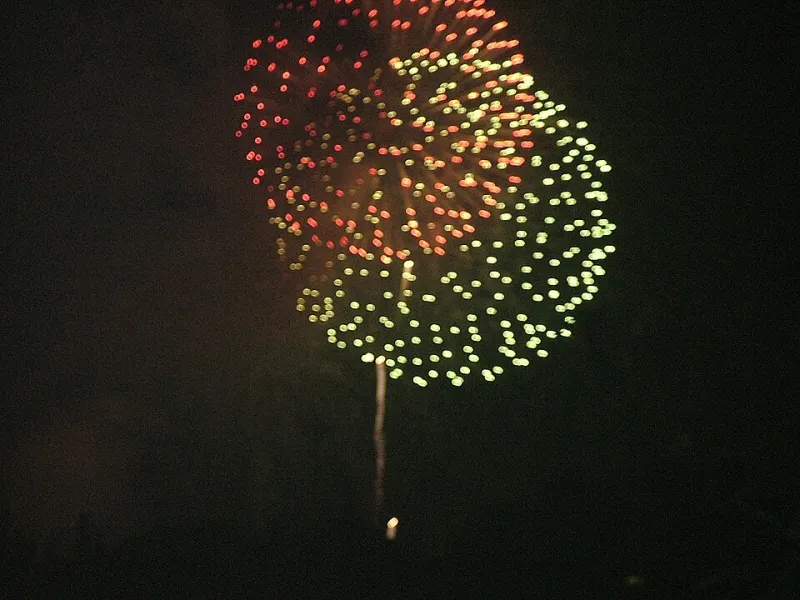
Photo: SuperJew, CC BY-SA 3.0, via Wikimedia Commons
Every July 4th, Americans set off roughly 15,000 tons of fireworks, and almost nobody in the crowd can tell you what's actually happening up there. Spoiler: it's not "colorful fire." It's a periodic table roll call, with each hue pointing to a specific element doing its signature move.
Once you know the cast, you'll never watch a fireworks show the same way again. You'll be that person at the lake saying "ooh, strontium" — and honestly, that's a good way to live.
The Color Roster: Who's Making What
Fireworks get their colors from two different tricks, and knowing which is which is half the fun.
The heat colors come from plain old incandescence — hot particles glowing. Deep orange and white sparks are usually bits of iron or steel filings burning as they fly. Magnesium and aluminum powders produce the blinding white flashes, which is why the biggest boom-and-flash shells feel like a camera flash you can feel in your chest. Magnesium burns so hot and bright that wartime flares and old camera flashbulbs rely on the same chemistry.
The element colors are the more interesting half. When certain metal atoms get heated, their electrons absorb energy, jump to higher orbits, and then fall back down — releasing that energy as light at very specific wavelengths. Each element has its own fingerprint:
- Strontium burns that impossible, saturated red — the color you see in emergency road flares, which are basically single-purpose fireworks. Fun fact: strontium is also what made old-school glow-in-the-dark watch dials shine, and it's chemically calcium's cousin, which is why it ends up in red emergency flare formulations.
- Barium delivers the greens. Barium chlorate and nitrate are the workhorses here, and the same element gives medical imaging its famous "barium meal" glow under X-rays. (Don't worry — the fireworks grade and the medical grade are very different products.)
- Copper produces blue, and here's a secret: blue is the hardest firework color to make. Copper compounds break down at high temperatures, so pyrotechnicians have to run a tightrope — hot enough to excite copper, cool enough that the compound survives. That's why a perfect deep-blue shell is considered the mark of a top-tier fireworks designer.
- Sodium is the yellow-orange you see, which is a bit of an embarrassment, because sodium contamination is everywhere and will happily turn any shell the wrong color. Formulators fight it constantly.
- Calcium gives orange, lithium gives crimson, and copper plus strontium together can fake violet.
So when the sky turns red-white-and-blue, you're watching strontium, magnesium, and copper performing a coordinated routine.
A Very Old Accident
Pyrotechnics go back a long way. The most common origin story points to China around the 9th century, when alchemists searching for an elixir of immortality instead mixed saltpeter, charcoal, and sulfur — and got gunpowder. Immortality: denied. Entertainment industry: founded.
For centuries, fireworks could only manage orange and white, because those are just the colors of burning material. The rainbow had to wait for 19th-century chemistry, when chemists figured out that metal salts could be added to formulations to produce specific colors. Suddenly pyrotechnicians had a palette. The American tradition of big public fireworks displays — which really took off after Congress authorized fireworks for Independence Day celebrations in 1777, the very first anniversary — got a serious upgrade.
The Mellow Cousin: Glow Sticks
Here's where it gets weird. Crack a glow stick and shake it, and you're running a chemical reaction that has something surprising in common with fireworks: chemiluminescence, light produced directly by a chemical reaction rather than by heat.
Inside that plastic tube are two compartments. One holds hydrogen peroxide; the other holds a phenyl oxalate ester and a fluorescent dye. Snap the tube, mix the two, and the reaction pumps energy into the dye molecules, which spit it back out as colored light — no flame, no heat, no strontium required. The dye you pick determines the color, not an element.
So a glow stick is basically a firework that decided to go to college and get a desk job. Same basic principle — excited electrons releasing energy as light — minus the explosion. Road flares sit somewhere in between: they use strontium chemistry like fireworks, but they're formulated to burn slowly and steadily instead of going bang.
Watching Like a Chemist
This July 4th, try a little party trick. When the show starts, call the colors:
- Deep red? Strontium.
- Bright green? Barium.
- Blue that actually looks blue? Somebody knows what they're doing.
- Blinding white with crackle? Magnesium, possibly with titanium flakes for the sound.
You'll sound like a genius, and the best part is you'll be right. Two hundred years of chemistry, a Chinese alchemist's failed immortality quest, and a handful of stubborn metal salts — all launched into the night sky, once a year, in your honor.
Happy Independence Day. Mind the barium.