Your Garage Is a Periodic Table: Mapping the Elements in a Typical American Car
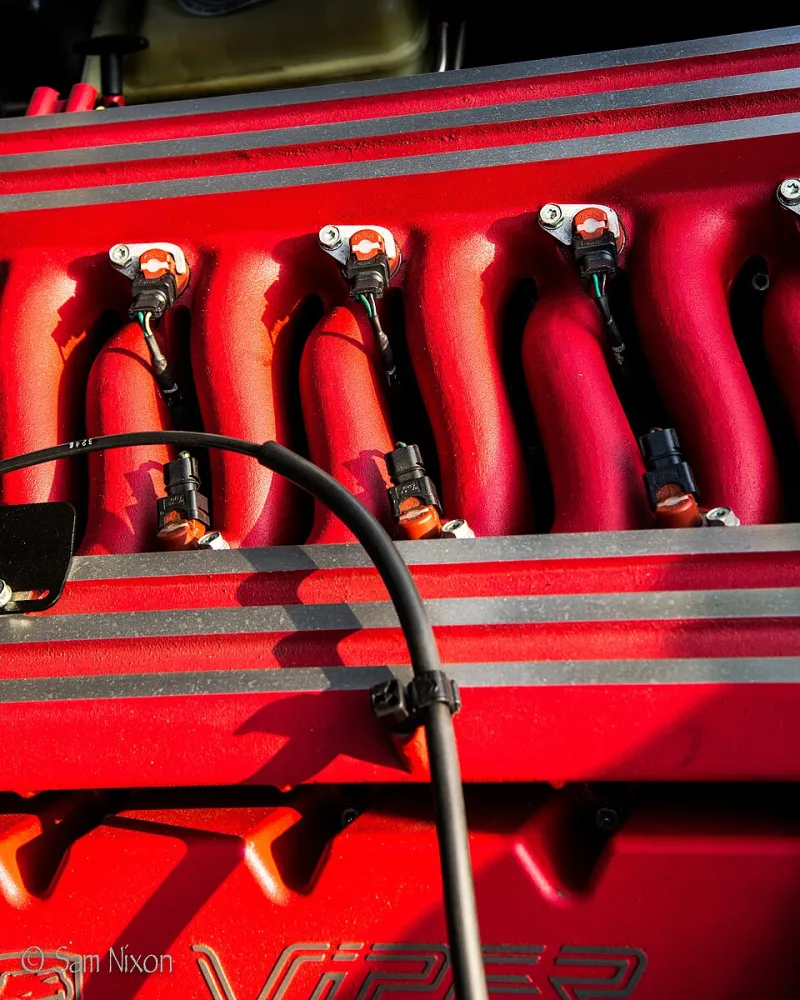
Photo: Sam Nixon, CC BY 3.0, via Wikimedia Commons
Pop the hood of any car in an American driveway and you're looking at the results of about a hundred and fifty years of people asking, "what's the best material for this specific job?" The answer, almost every time, was an element.
Compositions vary wildly by make, model, and trim — a base sedan and a loaded pickup are different beasts — but the general map holds up. Here's the rough lineup, in roughly the order you'd encounter it.
1. Iron and steel: the skeleton
Iron is still the backbone of the car, literally. The body-in-white, the frame, the suspension arms, the brake rotors — all iron, alloyed with carbon and a supporting cast of manganese, chromium, molybdenum, and vanadium that tune strength and corrosion resistance. A modern steel is a recipe as much as a material, and small additions of boron or niobium can be the difference between a crumple zone that folds correctly and one that doesn't.
2. Aluminum: the diet
Aluminum crept in through the engine bay first — cylinder blocks and heads — then spread to hoods, liftgates, and whole body structures. It's about a third the density of steel, which is why Ford's shift to an aluminum-bodied F-150 was such a big deal. Bauxite ore, electrolysis, enormous amounts of electricity, and a very good recycling stream: that's aluminum's biography.
3. Copper: roughly 50 pounds of nervous system
Wiring harness, motor windings, alternator, connectors, the little electric motors that move your mirrors and seats. Copper is the car's nervous system, and there is a surprising amount of it. In a battery-electric vehicle, that figure climbs toward 180 pounds or more.
4. Platinum, palladium, and rhodium: the exhaust chemistry set
A catalytic converter is a chemistry lab operating at several hundred degrees, converting carbon monoxide, unburned hydrocarbons, and nitrogen oxides into carbon dioxide, water, and nitrogen. The catalysts are platinum-group metals, and rhodium in particular is one of the most expensive materials on Earth by weight. This is why converters get stolen from parking lots — the chemistry is worth more than the steel around it.
5. Lead: the old-timer with a complicated past
Every gasoline car still carries lead in its 12-volt starter battery — typically with antimony, calcium, or tin alloyed in. It's one of the most successfully recycled objects in the US economy; lead-acid battery recycling rates run above 95 percent. Worth remembering, though, that lead's history with cars includes tetraethyl lead in gasoline, a public-health disaster that took decades to unwind.
6. Lithium, nickel, cobalt, manganese, and carbon: the EV newcomers
Swap the engine for a battery pack and this is the row that changes most. A lithium-ion cell pairs a cathode — various blends of nickel, cobalt, manganese, and aluminum — with a graphite anode made of carbon, all swimming in a lithium-salt electrolyte. Lithium itself is remarkably light: three protons, three electrons, and a willingness to give one up that makes it the best energy-storage element we've got.
7. Neodymium, dysprosium, praseodymium: the magnets
Rare-earth magnets live in electric motors, speakers, window lifters, and sensors. A small neodymium-iron-boron magnet can out-muscle a much larger conventional one, which is why they turned up everywhere once the manufacturing got cheap. Dysprosium gets added to keep the magnet working at high temperatures, which is exactly the condition inside a traction motor.
8. Indium: the invisible layer
That touchscreen is glass, an LCD or OLED panel, and a transparent conductive coating of indium tin oxide. Indium is genuinely scarce — not rare-earth scarce, but close to it — and it's one of those elements nobody thinks about until a supply chain analyst starts sweating.
9. Silicon: the brains
Dozens of microcontrollers, the infotainment brain, sensors, power electronics in hybrids and EVs. Silicon carbide is increasingly used in EV power inverters because it wastes less energy as heat.
10. Sulfur: the reason tires are black and stretchy
Rubber alone is squishy. Add sulfur and heat and the polymer chains cross-link into a resilient network — vulcanization, one of the great industrial chemistry tricks. Carbon black, itself mostly elemental carbon, gives tires their color and wear resistance.
11. Cerium and the glass shop
Cerium oxide is a superb polishing agent, used to finish windshields and mirrors to optical smoothness. A tiny, unglamorous element doing a job nothing else does as well.
Which ones keep procurement people up at night
A few of these are genuine chokepoints. Platinum-group metals come mostly from South Africa and Russia. Cobalt is heavily concentrated in the Democratic Republic of the Congo, with refining largely in China. Graphite for anodes is dominated by China, as is rare-earth processing — the Mountain Pass mine in California produces ore, though the midstream story is more complicated than the bumper sticker version.
None of this means the sky is falling. It means the periodic table has a geography, and the geography has politics.
What changes when the engine disappears
The catalytic converter goes away. Spark plugs — which often use iridium or platinum tips — go away. The lead-acid battery usually shrinks, though many EVs keep a small one for electronics. Oil, filters, and the whole lubrication chemical stack vanish from your maintenance schedule.
What arrives instead: a much larger battery, much more copper, serious rare-earth magnets, and a power-electronics stack built on silicon, silicon carbide, and a fair amount of tin in the solder joints.
Same periodic table. Very different shopping list.