Pocket-Sized Periodic Table: The Surprising Science Packed Into Your Phone
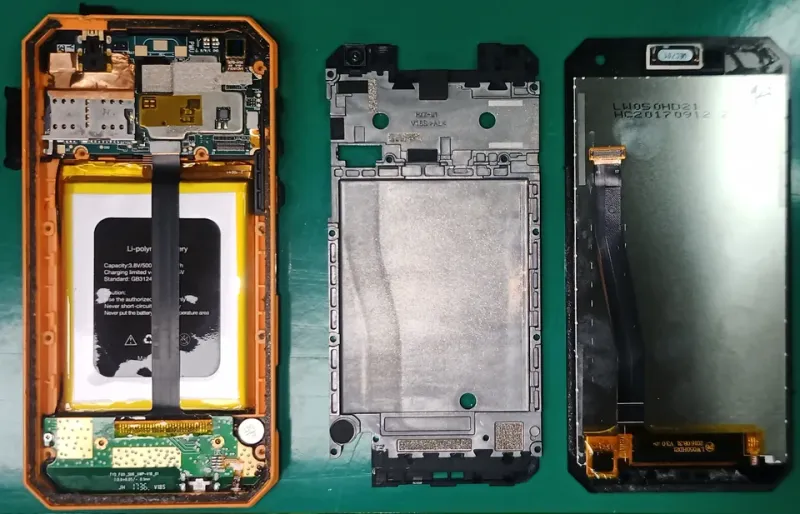
Photo: DungeonLords, CC BY-SA 4.0, via Wikimedia Commons
Take your phone out of your pocket for a second. Go ahead. Now consider this: you're holding something that contains over 60 different elements from the periodic table. Sixty. That's more than two-thirds of all the naturally occurring elements on Earth, crammed into a slab of glass and metal thin enough to lose between your couch cushions.
Your phone isn't just a technological marvel. It's a chemistry museum — one that fits in your hand and occasionally autocorrects your texts into something embarrassing.
Let's take a tour.
The Screen: Where Physics and Chemistry Get Flashy
The display is probably the first thing you notice about any phone, and it's also one of the more chemically interesting components. Modern OLED screens — the kind on most premium smartphones — rely on indium, a soft, silvery metal you've almost certainly never thought about. Indium tin oxide forms a transparent, electrically conductive layer that lets the screen respond to your touch while still passing light through.
The actual colors in an OLED display come from organic compounds (yes, carbon-based molecules again) that emit light when electricity runs through them. But getting specific colors right requires precise engineering, and that often involves elements like europium and terbium — rare earth elements that produce vivid reds and greens respectively. Without them, your Instagram feed would look a lot more washed out.
The glass itself? That's mostly silicon and oxygen, but Corning's Gorilla Glass (used on most major phones) incorporates aluminum oxide to improve scratch resistance, plus ion-exchange processes involving potassium to create compressive stress layers. Your screen is quietly doing structural chemistry every time you drop it face-down on the sidewalk.
The Processor: Where Silicon Gets Company
Everyone knows smartphones run on silicon chips. But calling a modern processor a "silicon chip" is a bit like calling a gourmet meal "some food." Technically accurate, wildly incomplete.
Modern chips are fabricated using extreme ultraviolet lithography, etching features just a few nanometers wide into silicon wafers. At those scales, pure silicon isn't enough. Gallium arsenide and indium phosphide semiconductors handle specific high-frequency signal processing tasks that silicon alone can't manage efficiently. Hafnium oxide is used as a gate dielectric in transistors — it replaced silicon dioxide in high-performance chips because it leaks less electricity at nanoscale dimensions, which means faster processing and longer battery life.
Germanium, silicon's older periodic table neighbor, also shows up in some chip architectures as a strain-inducing material that makes electrons move faster through the crystal lattice. It's essentially a performance enhancement for your processor at the atomic level.
The Battery: A Surprisingly Crowded Electrochemical Party
Lithium-ion batteries are named for the obvious star — lithium, element 3, the lightest metal on the periodic table. Lithium ions shuttle back and forth between electrodes during charging and discharging, storing and releasing energy in the process. It's elegant chemistry.
But lithium doesn't work alone. The cathode in most modern phone batteries is a layered material containing cobalt, nickel, and manganese in varying ratios. Cobalt provides stability; nickel increases energy density; manganese improves safety. The specific blend determines how long your battery lasts, how fast it charges, and how likely it is to do something dramatic if you puncture it.
The electrolyte — the medium that lithium ions travel through — typically contains phosphorus in the form of lithium hexafluorophosphate. And the anode? Mostly graphite (carbon again, showing up everywhere), though some manufacturers are starting to incorporate silicon nanoparticles into anodes to boost capacity.
Your battery is a precision-engineered electrochemical system involving at least six or seven elements, all cooperating to get you through a workday without hitting 20%.
The Speakers and Vibration Motor: Rare Earths Doing Physical Work
When your phone buzzes in your pocket, that's neodymium at work. Neodymium magnets — some of the most powerful permanent magnets known — are what drive the tiny vibration motor inside your device. The same principle applies to your phone's speakers: neodymium magnets interact with voice coils to convert electrical signals into physical vibrations you hear as sound.
Neodymium is a rare earth element, part of that famously confusing block of 17 elements at the bottom of the periodic table that most people ignored in chemistry class. Turns out those elements are absolutely everywhere in modern technology. Dysprosium is sometimes added to neodymium magnets to help them retain their magnetic properties at higher temperatures. Praseodymium can substitute for or complement neodymium in magnet alloys.
These elements aren't rare in the sense of being scientifically exotic — they're actually fairly abundant in Earth's crust. They're "rare" because they're geologically dispersed and expensive to extract and purify. Right now, the vast majority of the world's rare earth processing happens in China, which creates supply chain anxieties that keep a lot of tech executives up at night.
The Camera: A Lens Full of Surprises
Smartphone cameras have gotten genuinely remarkable, and part of that is chemistry. Camera lenses in phones often incorporate lanthanum-doped glass, which has a high refractive index that allows for thinner, lighter lens elements without sacrificing optical quality. Germanium shows up in some infrared-sensitive lenses used for night photography and face recognition.
The image sensor itself is silicon-based, but achieving accurate color reproduction requires precision coatings and filters that can involve a range of transition metals and rare earth compounds. The tiny actuators that drive autofocus mechanisms? Often piezoelectric materials containing lead zirconate titanate — yes, lead, the element that's toxic in most other contexts, quietly doing legitimate work inside your camera module.
So What Does All of This Mean?
It means that your phone is the product of essentially the entire history of chemistry. Every element in that device was discovered, characterized, and eventually put to use through centuries of scientific curiosity — from alchemists fumbling toward something they didn't understand, to 19th-century chemists systematically cataloging the elements, to 21st-century materials scientists engineering new compounds atom by atom.
It also means your phone is geopolitically complicated. Those 60-plus elements come from mines scattered across six continents. Some of them are subject to export controls, supply chain disruptions, and environmental controversies. The rare earths in your vibration motor might have come from Inner Mongolia. The cobalt in your battery likely passed through the Democratic Republic of Congo. Your pocket-sized periodic table has a global supply chain attached to it.
Next time you complain about your phone battery dying, maybe take a second to appreciate that you're carrying around one of the most element-dense objects humans have ever manufactured. The periodic table, it turns out, fits very nicely in your pocket.